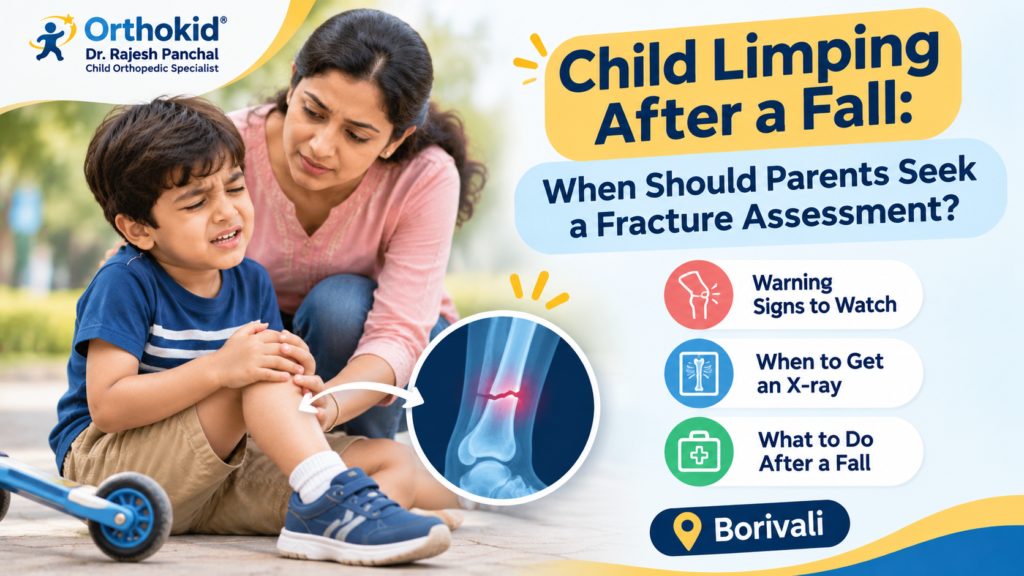
Child Limping After a Fall: When Should Parents Seek a Fracture Assessment?
Your child fell at home, in the playground or while playing sport—and now walks differently. Learn which signs need emergency care, when to arrange a fracture assessment, and what to observe safely before the visit.
If your child cannot walk or put weight on the leg, has severe pain, visible deformity, an open injury, numb or discoloured toes, or is feverish and unwell, seek emergency assessment. Even if the child can walk, persistent pain, swelling or a new limp may need prompt medical review to rule out a fracture.
Why is my child limping after a fall?
Limping is a change in walking, often because a child is protecting a painful leg or cannot move a joint normally. After a fall, possible causes include a bruise, muscle or ligament injury, a fracture, or an injury near a growing bone’s growth plate.
A child does not have to cry continuously, develop obvious swelling or have a visibly bent leg to have a fracture. Young children may only avoid standing, ask to be carried or crawl after they previously walked. The Royal Children’s Hospital describes this pattern in toddler’s fractures.
When should parents seek a fracture assessment?
The appropriate urgency depends on how the child is behaving, whether they can bear weight, the appearance of the limb, and any associated symptoms. This guide is not a substitute for an examination.
Seek emergency care now
Go to the nearest emergency department rather than waiting for a routine appointment if any of these apply:
- Unable or refusing to stand, take steps or bear weight after the injury.
- Severe or rapidly increasing pain; obvious deformity; a deep/open wound or bone visible.
- Foot or toes are cold, blue/pale, numb, or difficult to move.
- A swollen, very painful joint with fever or a child who appears generally unwell.
- A high-impact fall, possible head/neck injury, or multiple injuries.
Arrange prompt medical evaluation—ideally the same day
A child who can still walk may nevertheless have a fracture. Seek medical advice promptly when you notice:
- A persistent or worsening limp, even after rest.
- Localized bone tenderness, ankle/knee/foot swelling or bruising.
- Pain when walking, reluctance to play, or guarding one leg.
- Ongoing limp after a twisting incident or fall in a toddler.
The clinician will decide whether X-rays or other assessment are needed.
Brief observation may be reasonable only when symptoms are mild and clearly improving
For a minor bump, if your child is comfortable, bearing weight normally, has no localized tenderness, deformity, significant swelling or fever, and returns promptly to their usual walk, simple rest and observation may be enough.
If a limp continues, returns or worsens, arrange an assessment. Do not use a waiting period to override any of the warning signs above.
Clinical guidance identifies acute inability to walk or bear weight as a red flag. A parent cannot reliably rule out a fracture by looking at the leg alone. Source: Royal Children’s Hospital clinical guideline.
Fractures that can be easy to miss
Some childhood fractures are subtle. An examination identifies the most likely site of injury and whether imaging is appropriate; the type of fracture cannot be diagnosed at home.
Toddler’s fracture
A small, often stable crack in the shin bone (tibia), typically after a low-energy twist or fall. A young child may suddenly limp, refuse to walk or switch back to crawling, sometimes without visible swelling.
Growth-plate injury
Growth plates are developing regions near the ends of children’s bones. Pain or tenderness near a joint after injury can need timely assessment, even when the first X-ray appears normal.
Foot or ankle fracture
A fall, awkward landing or sports incident can injure bones around the ankle or foot. Pain in one spot, swelling and trouble walking deserve attention; do not label every swollen ankle a sprain.
Injury higher up the leg
Children may indicate knee pain when the problem is at the hip, or limp without pointing to an exact location. A clinician may examine the hip, knee, shin, ankle and foot to find the source.
Why a normal X-ray may not end the story
Some hairline fractures and growth-plate injuries are not obvious on early imaging. If pain or limping persists, the clinician may recommend protection, reassessment, repeat imaging or another investigation according to the findings.
References: RCH toddler’s fracture and NIAMS growth-plate injuries.
For more background on why treatment plans vary, read OrthoKid’s existing guide to fractures in children.
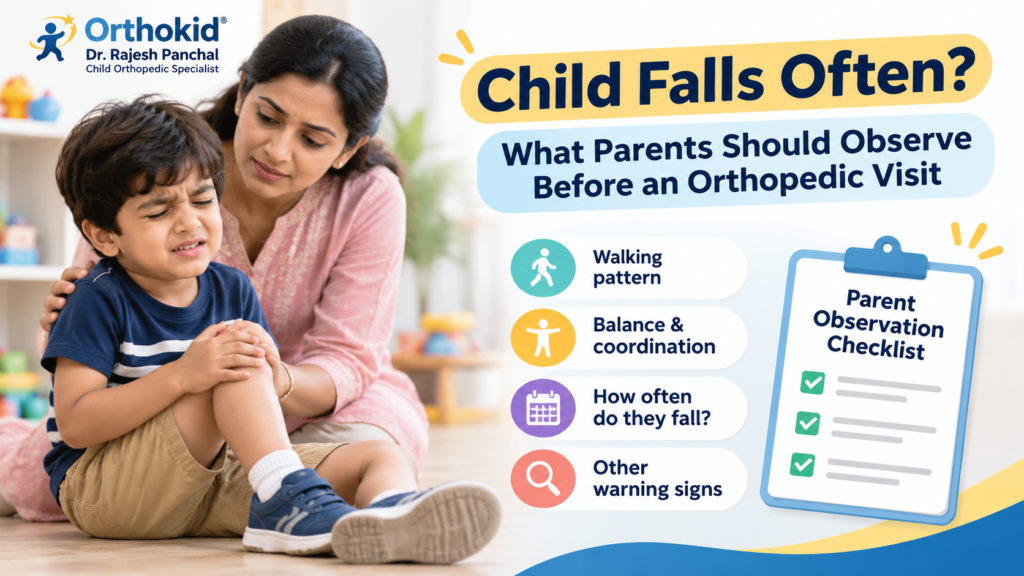
Six things parents should notice before the visit
Document what you can safely observe. Do not make your child walk, jump or hop to prove whether the leg is injured. A short video is useful only if they are already walking voluntarily and comfortably.
What happened?
Was it a slip, twist, direct impact or fall from height? Record where and roughly when it happened.
Can they bear weight?
Notice if they stand willingly, favour one leg, ask to be carried or refuse to walk.
Where is the pain?
Foot, ankle, shin, knee, thigh or hip? A young child may point vaguely or only react to movement.
What can you see?
Swelling, bruising, unusual position, a wound or colour change. Compare sides visually without squeezing.
Is it changing?
Note whether pain or limping is improving, unchanged or worsening since the fall.
Any other symptoms?
Fever, unusual tiredness, severe night pain, weakness or a generally unwell appearance may change the urgency.
What parents can do—and what to avoid
Helpful first steps
- Pause running, sports, jumping and climbing.
- Let the child rest in a comfortable position; minimise weight-bearing if walking hurts.
- For a mild closed soft-tissue injury, use a cool pack wrapped in cloth for a short interval, never directly on skin.
- Keep an injured limb supported and contact a medical professional if a fracture is possible.
- Use age-appropriate pain relief only according to professional advice or the medicine’s instructions.
Things not to do
- Do not force walking or stretching to “test” the leg.
- Do not massage, twist, pull or try to straighten a painful or deformed limb.
- Do not assume there is no fracture just because the child can move toes or walk a few steps.
- Do not try to push a protruding bone or displaced joint back into place.
- Do not delay emergency care to obtain a routine clinic booking.
For an open wound or suspected serious fracture, protect the area from further movement and seek emergency care. First aid is not a replacement for professional fracture management.
How is a suspected fracture assessed?
A paediatric orthopaedic assessment is guided by the injury mechanism, the child’s age, where symptoms appear and clinical findings. Not every limp needs every test.
- Listen to the injury story
The clinician asks when and how the fall happened, whether the child could walk afterward, where it hurts and whether symptoms have changed.
- Examine the whole relevant limb
They check tenderness, swelling, alignment, gentle movement and circulation, and may examine joints above and below the painful area.
- Choose investigations if indicated
An X-ray may be recommended when a fracture is suspected. Additional imaging or tests are considered only if the examination suggests a need.
- Explain the plan and follow-up
Care could involve rest, support, splinting, a cast or other treatment. Some injuries require urgent hospital management; subtle fractures may need review even if initial X-rays are normal.
Parent checklist: what to tell the doctor
Use this one-page note to prepare for the consultation. The checklist is a memory aid, not a home fracture test. You can print this webpage from your browser or write these details on your phone.
Before the appointment, make a note of:
Tick only what you have actually observed. Seek urgent help first if emergency signs are present.
Quick injury record
| Detail | Your notes | Question for the clinician |
|---|---|---|
| When / how the fall happened | ||
| Where the pain or limp is | ||
| Walking / weight-bearing since fall | ||
| What has changed since the injury |
Bring existing imaging, discharge summaries and relevant medicine details. Do not delay emergency assessment to complete this form.
How soon can a child walk and play normally again?
There is no single safe timetable for all injuries. The recovery plan depends on whether the cause is a bruise, sprain, toddler’s fracture, growth-plate injury or something else. Some minor injuries improve quickly; other injuries require immobilisation, follow-up or rehabilitation.
Follow the examining clinician’s instructions about weight-bearing, casts or boots, pain management, school, sport and follow-up. Do not return to running or playground activities while the child still limps or has pain. If symptoms worsen or reappear, get reassessed.
Read OrthoKid’s guide to returning to play after a paediatric injury once the injury has been evaluated.
Fracture and limping assessment for children in Borivali
If your child is limping after a fall in Borivali or nearby western suburbs of Mumbai, Dr. Rajesh Panchal, Paediatric Orthopaedic Surgeon and founder of OrthoKid, offers consultations for children’s fractures and walking-related concerns. Borivali clinic visits are by prior appointment. See the official Borivali East clinic page.
For an emergency sign, go directly to an emergency department. The routine appointment service is not emergency triage.
OrthoKid at Shreel Wellness · Borivali East
Shop No. 8, New Jalaram Bhuvan CHSL, Carter Road No. 3, Amba Mata Chowk, opposite Casa Pallazo, Borivali East, Mumbai, Maharashtra 400068, India.
Appointments: +91 88798 23511 · By prior appointment. Confirm the exact clinic, date and time before travelling.
Families also visit from Dahisar, Kandivali and neighbouring western suburbs. The Dahisar East clinic is a separate consultation location.
The OrthoKid website also lists hospital affiliations with Wockhardt (Mira Road), Thunga and Criticare (Malad), and Apex Group of Hospitals (Borivali). Confirm current hospital and emergency-service arrangements directly; these affiliations do not replace emergency triage.
Frequently asked questions
My child can still walk after a fall. Could it still be a fracture?
Yes. Some stable or subtle fractures allow limited walking. Persistent limping, pain over a bone, swelling or guarding a leg after a fall should be medically assessed even without an obvious deformity.
My toddler fell and now wants to crawl instead of walking. What should I do?
A sudden refusal to walk or put weight on a leg needs urgent medical assessment. A toddler’s fracture is one possibility, but other causes must also be considered.
Does every child with a limp need an X-ray?
No. A clinician decides based on the injury, age, examination and warning signs. X-rays are commonly used when a fracture is suspected, but they are not required for every limp.
Can a child’s X-ray be normal even when a fracture exists?
Yes. Some toddler’s fractures and growth-plate injuries are difficult to identify on an early X-ray. If symptoms persist, follow the clinician’s reassessment plan rather than assuming the injury has been ruled out.
Should I wait until tomorrow if my child has a limp but no swelling?
No swelling does not reliably exclude injury. If your child refuses to bear weight or has severe pain, seek emergency care now. If they are walking but continue to limp or have localised pain, arrange prompt medical review, ideally the same day.
My child has fever and is limping. Is it just because they fell?
Do not assume so. Fever with a painful limp, particularly with inability to bear weight or a swollen painful joint, can suggest a serious condition such as bone or joint infection and needs urgent hospital assessment.
Is it safe to massage the leg after a playground fall?
Avoid massage or forced stretching when a fracture or significant injury is possible. Rest and protect the limb, and seek professional evaluation for pain, swelling or persistent limping.
What should I carry for a pediatric orthopedic fracture assessment?
Bring available X-rays and reports, previous injury or treatment records, a medication list, and a brief account of what happened. A video of naturally occurring walking may help only if it can be recorded without asking the child to walk through pain.
Where can I ask about a child fracture assessment in Borivali East?
OrthoKid’s Borivali East clinic is at Shreel Wellness, Carter Road No. 3, Amba Mata Chowk. Call +91 88798 23511 to confirm an appointment. If your child has emergency warning signs, use an emergency department rather than waiting for a clinic slot.
Related OrthoKid resources
Medical references
This educational guide draws on published paediatric orthopaedic and emergency care information. It should be clinically reviewed and approved by OrthoKid before publication; it does not claim individual authorship or medical review by Dr. Rajesh Panchal.
- The Royal Children’s Hospital — The limping or non-weight bearing child (clinical practice guideline).
- The Royal Children’s Hospital — Toddler’s fracture (parent information).
- AAOS OrthoInfo — The Limping Child.
- National Institute of Arthritis and Musculoskeletal and Skin Diseases — Growth-plate injuries: diagnosis and treatment.
Concerned about your child’s limp after a fall?
For non-emergency concerns, contact OrthoKid’s Borivali East clinic to discuss an appointment. For inability to walk, a deformed limb, severe pain, circulation changes or other emergency signs, go to the nearest emergency department.
Medical disclaimer: This page provides general parent education and is not a diagnosis, imaging recommendation or substitute for an examination. Urgent symptoms require urgent clinical care. OrthoKid does not provide emergency response through this article.