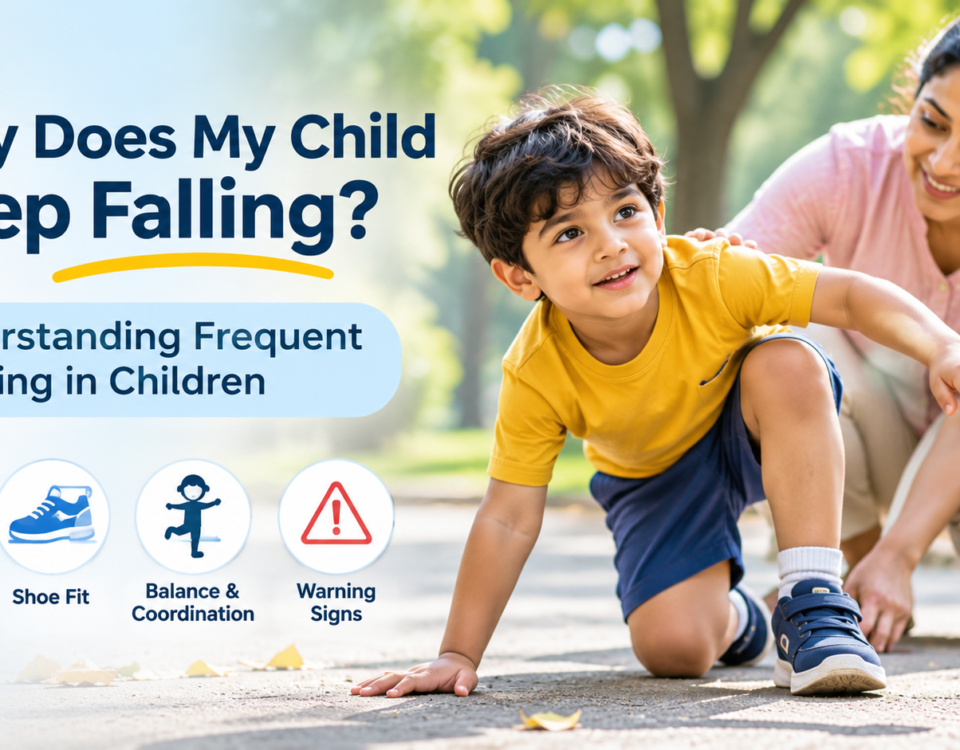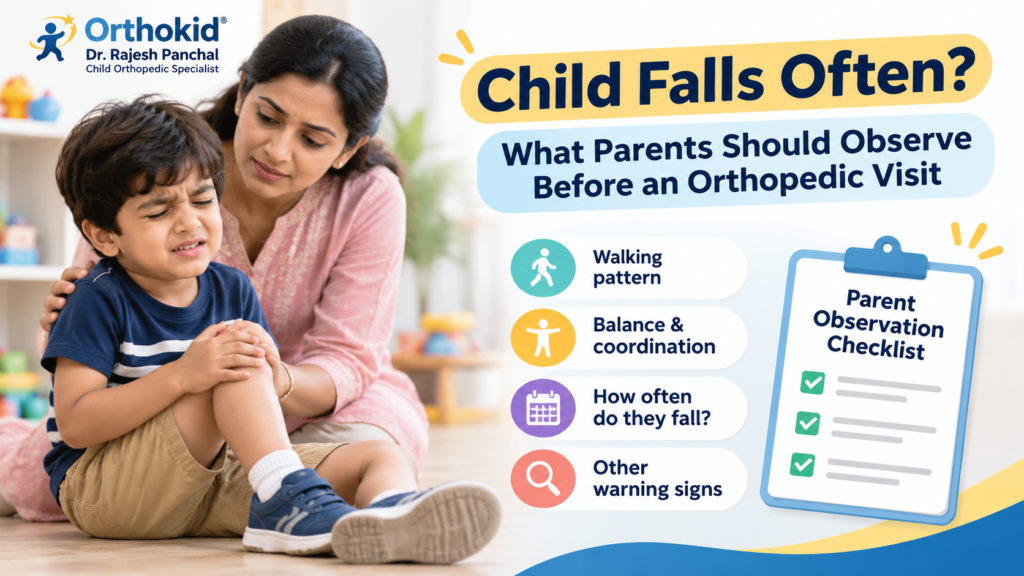
Child Falls Often: What Parents Should Observe Before an Orthopedic Visit
When your child keeps tripping, the most helpful first step is to notice when it happens, what their walking looks like, and whether anything has changed. This practical guide helps parents in Borivali and nearby Mumbai suburbs prepare useful observations for a medical assessment.
Quick answer for parents
Occasional trips are common while children develop coordination. A repeated, worsening or one-sided pattern—especially with pain, limping or loss of skills—deserves medical attention. A short description and a safe walking video can make your visit more informative.
- No universal “falls per day” cutoff diagnoses a problem.
- Look for pattern, changes and associated symptoms.
- Do not wait for a routine visit if urgent warning signs appear.
Is it normal for a child to fall often?
Children learning to walk, run, turn quickly or navigate uneven ground can lose balance. Their coordination and confidence develop over time, so an occasional fall during energetic play does not automatically point to a bone, muscle or nerve condition.
What matters more than a single number is whether your child is walking comfortably, playing normally for their age, developing new skills and showing a stable or improving pattern. Falls that appear suddenly, occur on level ground without an obvious obstacle, increasingly affect everyday activities or come with other symptoms should be assessed.
Often worth observing
A newly walking toddler occasionally tumbles while changing direction, gets up comfortably, uses both legs similarly and continues playing without pain.
Worth discussing with a clinician
A child who previously moved confidently starts stumbling more, repeatedly drags one foot, develops a limp, avoids activities or complains of leg or joint pain.
Eight things to observe before the orthopedic visit
If your child falls frequently in Borivali or elsewhere in Mumbai, these are useful details to share with the doctor. Observe ordinary, safe activities; you do not need to perform physical tests or deliberately make the child fall.
Where and when does it happen?
Notice whether it happens on flat flooring, while running, during turns, on uneven ground or after long periods of play.
Is the pattern changing?
When did you first notice it? Is it improving as your child grows, staying the same or becoming more frequent?
Which foot or leg is involved?
Look for repeated tripping on the same side, one foot turning noticeably inward, one toe catching the floor or an uneven stride.
Is there pain, limping or stiffness?
Ask gently if a foot, ankle, knee, hip or leg hurts. Notice swelling, a change in movement, stiffness or a limp.
What happens with tiredness?
Does your child move normally at first but stumble after play? Do they tire unusually quickly or struggle more on stairs?
Have any movement skills changed?
Notice difficulty getting up from the floor, walking, climbing or keeping up with everyday play—particularly if skills were previously easy.
Could the surroundings contribute?
Record slippery floors, obstacles, unsuitable footwear and whether the same tripping occurs barefoot and in shoes.
Is there relevant background?
Remember any recent injury, fever, illness, previous foot or leg concern, developmental issue or feedback from school/daycare.
How to record a helpful walking video safely
A short clip can sometimes show a pattern that is difficult to reproduce during a clinic examination. It is optional and should only be recorded if your child can walk comfortably and safely.
- Choose a familiar, level and obstacle-free space
Record ordinary walking in good light. Do not use stairs, slippery floors, rough ground or a high-risk activity just to capture a fall.
- Capture a natural walk from the front, side and behind
A few short clips can show foot direction, balance and whether both sides move similarly. Keep your child’s full legs and feet in the frame.
- Include running only if already comfortable and safe
If tripping happens during normal play, an existing video may be useful. Never ask your child to run through pain or repeat an unsafe movement.
- Keep the footage private
Show it directly to the treating clinician. Avoid publicly sharing identifiable images of your child or other children without permission.
When should parents seek medical attention?
Repeated falls alone do not diagnose a serious condition. The appropriate urgency depends on symptoms, sudden changes and how well your child can move. The examples below are a practical guide, not a substitute for clinical triage.
Seek urgent medical care now
Go to an emergency department or obtain urgent medical assessment if your child:
- Suddenly cannot walk, stand or bear weight, or has severe pain after an injury.
- Has a new limp with fever and a painful, hot or swollen joint.
- Develops sudden or rapidly worsening weakness, loss of balance or inability to walk.
- Has a major injury, obvious deformity or significant head-injury symptoms such as unusual drowsiness or repeated vomiting.
Arrange a timely medical appointment
Book an evaluation if falling or tripping is persistent, worsening, repeatedly one-sided or interferes with play, school or everyday activities. Other reasons include a continuing limp, recurrent unexplained pain, foot dragging, noticeable asymmetry or loss of a previously learned motor skill. Motor-skill regression warrants prompt pediatric assessment, even without pain.
Observe calmly when your child is otherwise well
Occasional trips in an active, developing child who walks comfortably, continues to gain skills, uses both sides similarly and has no concerning symptoms may be monitored. If you remain concerned, ask your pediatrician rather than waiting for a fixed number of falls.
Clinical reference: Royal Children’s Hospital guidance on limping or non-weight-bearing children and AAOS OrthoInfo on the limping child.
Parent observation checklist before your child’s appointment
Use this as a memory aid. Tick only what you have actually observed. Checking an item does not indicate a diagnosis, and leaving everything blank does not rule out a problem. The checkboxes remain on this page only; nothing is submitted or saved.
A simple 7-day observation log
You do not need to wait seven days to obtain care. Use this only if your child is well and there are no warning signs. Print the page and add short notes as events occur.
| Day | When / activity | What you noticed | Pain or other symptoms? |
|---|---|---|---|
| Day 1 | |||
| Day 2 | |||
| Day 3 | |||
| Day 4 | |||
| Day 5 | |||
| Day 6 | |||
| Day 7 |
You can print using your browser’s Print command (Ctrl/Cmd + P). Count and timing may help describe the pattern, but there is no single medically validated fall-count threshold that applies to every child.
What to bring and what to tell the orthopedic doctor
Bring, if available
- Your short observation notes or printed diary
- Walking videos recorded safely
- Regular shoes that your child uses
- Previous imaging, reports or prescriptions
- Any school or daycare observations
- List of medicines, illnesses or recent injuries
Be ready to describe
- Age at which your child began walking
- When the falls started and whether they have changed
- Whether the same leg seems involved repeatedly
- Any discomfort, weakness, fatigue or stiffness
- Changes in running, climbing, standing or play
- Your main questions and concerns
“My child started tripping more over the past month, especially while turning. It appears to involve the left foot, and I have a short clip.” That kind of specific description can be more useful than trying to name a condition yourself.
For a broader idea of clinic preparation, read OrthoKid’s guide to what happens during a child’s first orthopedic consultation.
What may happen during a pediatric orthopedic assessment?
A consultation aims to understand why a child is falling—not simply to count falls. An orthopedic specialist may review the history and observe movement, while considering whether pediatric, neurological, visual or developmental assessment is also appropriate.
History & growth
Discussion of development, previous illness or injury, symptoms, and what you have observed at home or school.
Movement examination
Observation of walking, joint movement, foot and leg alignment, balance, strength and other findings as clinically indicated.
An individual plan
Explanation of findings, whether tests or another specialist are needed, and appropriate follow-up or treatment if indicated.
Not every child needs an X-ray or scan. Decisions are based on the history and examination, including signs of injury, infection or another condition requiring investigation.
Frequently asked questions
My child falls frequently in Borivali. Should I see an orthopedic doctor?
Occasional falls can be part of development, especially when learning new motor skills. Seek an assessment if the pattern persists or worsens, happens repeatedly without a clear trigger, seems one-sided, or affects play or walking. Pain, limping and other warning signs also matter. Your pediatrician can help identify whether pediatric orthopedics or another specialist is most appropriate.
How many falls a day are too many?
There is no universal medically validated number that applies to all children. Age, developmental stage, the activity, change over time and associated symptoms are more informative than an isolated daily count.
Should I record my child walking before the appointment?
A brief, natural walking video may help demonstrate the pattern. Record only on safe, level ground while your child is comfortable. Avoid provoking falls or making a child walk or run through pain.
Can in-toeing or flat feet explain frequent tripping?
Some foot or leg alignment patterns can be associated with tripping, but they do not explain every case. Many childhood alignment variations are age-related and require no treatment. An individual examination is needed to understand whether an observed pattern is clinically relevant.
Does every child who falls often need an X-ray?
No. A clinician first considers the history and examination. Imaging or other tests may be recommended if there are specific findings, such as suspected injury, persistent painful limping or signs of another condition.
What if my child suddenly starts limping or refuses to walk?
Sudden inability to bear weight, serious pain, rapid weakness or a limp accompanied by fever and a painful swollen joint needs urgent medical evaluation. Do not delay for a routine orthopedic appointment.
What if my child has lost skills they could do before?
Loss of previously achieved motor skills is a reason for prompt medical assessment, even if there is no pain. A pediatrician may coordinate further neurological or developmental assessment when indicated.
Where can I book a pediatric orthopedic visit in Borivali East?
OrthoKid at Shreel Wellness is at Shop No. 8, New Jalaram Bhuvan CHSL, Carter Road No. 3, Amba Mata Chowk, opposite Casa Pallazo, Borivali East, Mumbai, Maharashtra 400068. Call +91 88798 23511 and confirm availability before travelling.
Discuss your child’s walking concerns with OrthoKid
Dr. Rajesh Panchal is a pediatric orthopedic surgeon and founder of OrthoKid. If your child has a persistent walking concern, a clinical evaluation can help identify the appropriate next step.
Consultations are by prior appointment. Confirm the clinic location and doctor’s availability before travelling. Emergencies need prompt medical care rather than a routine booking.
Visit OrthoKid at Shreel Wellness
Shop No. 8, New Jalaram Bhuvan CHSL,Carter Road No. 3, Amba Mata Chowk,
opposite Casa Pallazo, Borivali East,
Mumbai, Maharashtra 400068, India.
Get directions to Borivali East
Also serving families around Borivali, Kandivali and Dahisar. See Dahisar East clinic details.
Clinical references and further reading
- Royal Children’s Hospital Melbourne — The limping or non-weight-bearing child. Assessment, urgent red flags and examination.
- American Academy of Orthopaedic Surgeons — The Limping Child. What parents may be asked and how clinical examinations work.
- Paediatric Musculoskeletal Matters — Clumsiness. Development, functional changes and features that warrant attention.
- American Academy of Pediatrics — Motor delays: early identification and evaluation. The importance of developmental regression and clinical assessment.
Clinical references support general medical information. They do not endorse OrthoKid or replace an examination. Page content should be reviewed by the treating clinician before publication.