Toe Walking in Children: When Is It Normal and When to Seek Assessment?
Does your child walk on tiptoes instead of putting their heels down? Learn which patterns can be part of early walking development, which changes deserve attention, and how a paediatric orthopaedic assessment in Mumbai can help.
Is toe walking in children normal?
Sometimes, yes. Walking on the toes for short periods can be a typical part of learning to walk. Many toddlers alternate between heel-to-toe steps and tiptoe steps as balance and coordination develop.
If your young toddler toe walks occasionally, uses both feet similarly, can put the heels down and is developing well, there may be no serious cause. If toe walking is persistent around or after age three—or occurs with pain, stiffness, weakness, frequent falls, asymmetry or a new change in walking—book an assessment. Some warning signs deserve attention at any age.
Parents searching for toe walking in children in Mumbai often want to know whether to monitor it, try exercises, or see a specialist. The right choice depends on the child’s age, walking history, ankle movement and any associated symptoms—not on toe walking alone.
What exactly is toe walking?
Toe walking describes a gait in which a child places most of their weight on the balls of the feet, with little or no heel contact during steps. It may happen intermittently or nearly every time the child walks.
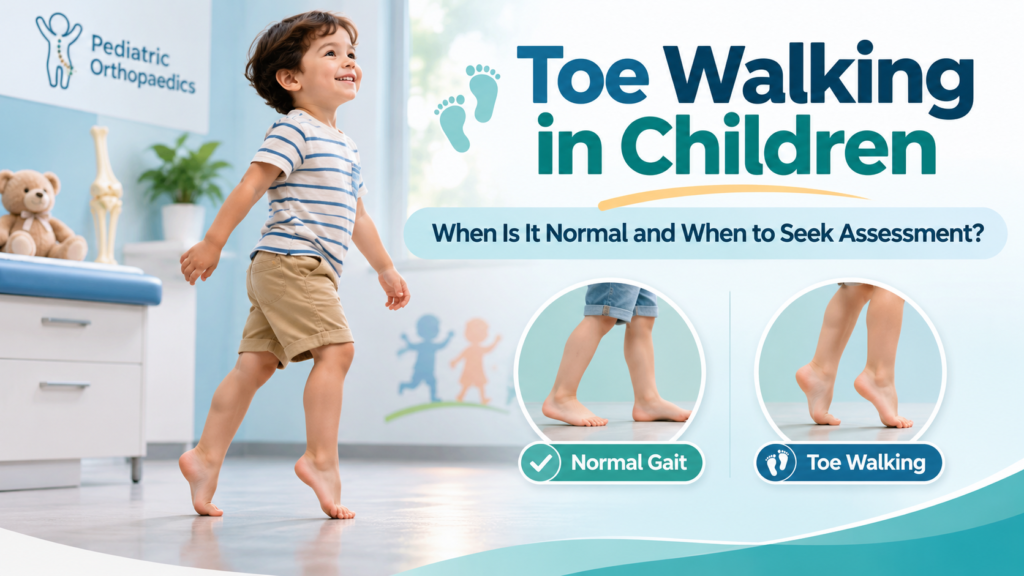
Heel-to-toe walking
The heel makes contact with the ground as the child steps, then weight moves towards the front of the foot. This becomes the usual walking pattern as gait matures.
Toe walking
The heel stays lifted, or barely touches the floor, while the child moves forward mainly on the forefoot. The pattern may be bilateral or more noticeable on one side.
A child who can comfortably stand flat-footed but chooses to walk on their toes is different from a child who physically cannot lower their heels. The distinction is useful, but it does not by itself establish a diagnosis.
When is toe walking a normal phase?
There is no single birthday that separates every normal walking variation from a medical issue. These age bands are a practical guide; symptoms and examination findings matter more than age alone.
New walkers to around 2 years
Occasional toe walking can occur while children learn balance and coordination. Watch whether the child also takes flat-footed steps and progresses with other movement milestones.
Usually observe if otherwise wellLook for a settling pattern
Tiptoe walking often becomes less frequent. If it is happening most of the time, concerns you, or your child cannot bring their heels down, speak with a healthcare professional.
Discuss persistent patternsPersistent toe walking needs a check
Ongoing toe walking after around age three should be assessed, even if it is painless, to consider ankle flexibility, gait, neurological and developmental factors.
Arrange a clinical assessmentAge is not a safety test. New, one-sided or painful toe walking, difficulty putting heels down, loss of skills or weakness should be assessed regardless of your child’s age. See the warning signs below.
When should parents seek an assessment?
Not every toe-walking child needs treatment. However, some features suggest that the walking pattern deserves a closer look, and a smaller group of symptoms needs prompt medical care.
Book a clinical assessment
- Toe walking is continuing beyond the early toddler years, especially after age three.
- The heels cannot comfortably reach the ground when standing or walking.
- One side toe walks more than the other.
- Your child falls often, has reduced balance, calf tightness, discomfort, or struggles to keep up during play.
- Developmental milestones are delayed, or you notice other movement or coordination concerns.
- The toe walking started after your child had previously walked with the heels down.
Seek urgent medical advice
- A sudden change in walking with significant weakness, new difficulty standing, or loss of previously achieved movement skills.
- Severe pain, fever with a new limp, a swollen joint, or refusal / inability to bear weight.
- New bladder or bowel control problems, altered groin sensation, or significant back symptoms with gait changes.
- Symptoms worsening rapidly or appearing after a significant injury.
If a child is acutely unwell or cannot walk, seek an appropriate emergency service rather than waiting for a routine clinic appointment.
Describe the pattern and any symptoms when you call OrthoKid. The clinic can help arrange an appropriate consultation; urgent symptoms require emergency care.
Why does a child walk on their toes?
There is more than one possible reason. A paediatric orthopaedic evaluation focuses on understanding the pattern rather than assuming every child has the same cause.
Habitual / idiopathic pattern
Some otherwise healthy children keep a tiptoe pattern without an identifiable medical cause. “Idiopathic” is used only after other possible reasons have been considered.
Calf or Achilles tightness
Reduced ankle movement can make it difficult to place the heels on the ground. Tightness may be associated with a longstanding toe-walking pattern or another condition.
Sensory or developmental factors
Some children show toe walking alongside sensory preferences or developmental differences. Toe walking alone does not diagnose autism or another developmental condition.
Less common medical causes
Occasionally, a neurological, muscle or orthopaedic condition contributes to the gait pattern. Associated weakness, asymmetry or changes in skills guide further evaluation.
Important: The names above describe possibilities, not a diagnosis for any individual child. See clinical references from AAOS OrthoInfo and the European Paediatric Orthopaedic Society.
How is toe walking assessed?
A useful assessment is more than watching a child take a few steps. The clinician considers the child’s history, growth, flexibility, strength and any associated concerns.
At OrthoKid in Mumbai, families can request a consultation for paediatric walking-pattern concerns with Dr. Rajesh Panchal, a paediatric orthopaedic surgeon.
Do children need an X-ray or MRI? Not routinely. Many cases can be assessed with history and physical examination. Tests are considered only if the findings suggest they may help.
History and milestones
When did toe walking start? Is it on both sides? Was it always present? Are there pain, falls, family history or developmental concerns?
Walking and movement observation
The clinician watches the child walk naturally, tries a flat-footed walk when appropriate and may assess balance, running and getting up from the floor.
Flexibility and physical examination
Ankle movement, calf and Achilles tightness, foot alignment, leg symmetry, strength and reflexes may be assessed according to the child’s needs.
Individual next-step plan
The outcome may be reassurance and observation, targeted therapy, follow-up or additional investigations / referrals when clinically indicated.
Does toe walking in children need treatment?
Not always. Treatment depends on what is causing the pattern, whether ankles are flexible, the child’s age and whether walking affects comfort or everyday activities. Possible approaches include:
Observation and follow-up
For a well child with a flexible, improving pattern and no concerning findings, the clinician may advise monitoring over time rather than immediate treatment.
Physiotherapy and movement work
Individualised stretching, strengthening, balance or gait activities may be recommended after assessment. The approach should match the child’s needs and tolerance.
Braces, casting or surgery
For persistent or significant tightness, some children may be considered for orthoses or serial casting. Surgery is reserved for selected cases and is not a routine first step.
Before trying treatment at home: Avoid forcing your child’s heels down, aggressive calf stretching, or purchasing braces / corrective shoes without an assessment. These may be inappropriate for the underlying cause. Evidence and response vary by child.
A parent’s simple observation checklist
You do not need to diagnose your child’s gait at home. A few observations can help the doctor understand what you are seeing between clinic visits.

Dr. Rajesh Panchal
Paediatric Orthopaedic Surgeon · Founder, OrthoKid
Read the doctor’s profile ↗What to bring
Bring earlier medical reports if available, your child’s relevant developmental history and a few walking videos. Mention previous treatment, physiotherapy, braces or casts, if any.
What families should expect
Clinical advice should explain whether the pattern appears to be a normal variation, what needs monitoring and why any therapy, follow-up or further testing is being recommended.
Request a toe-walking assessment at OrthoKid
Dr. Rajesh Panchal sees children with walking, limb and foot concerns. OrthoKid lists clinics in Borivali East and Dahisar East, which may be convenient for families travelling from nearby western suburbs including Kandivali and Mira Road. Call first to confirm the location and available consultation slot.
OrthoKid at Shreel Wellness
Shop No. 8, New Jalaram Bhuvan CHSL, Carter Road No. 3, Amba Mata Chowk, opposite Casa Pallazo, Borivali East, Mumbai, Maharashtra 400068, India.Shree Vishwasanjeevani Polyclinic
Ramkunwar Thakur Marg, Misquita Nagar, Krishna Colony, Dahisar East, Mumbai, Maharashtra 400068, India.Call +91 88798 23511, message the clinic or check its existing online booking system. Slot availability and clinic timings should be confirmed directly.
Frequently asked questions about toe walking
Clear answers to common questions about toe walking in toddlers and children, including when a specialist consultation in Mumbai may help.
Is toe walking normal for a 2-year-old?
Occasional toe walking at this age may be a normal part of learning to walk. If it is constant, only on one side, painful, associated with developmental concerns or the child cannot bring their heels down, arrange an assessment rather than waiting.
Should I worry if my 3-year-old still walks on tiptoes?
Persistent toe walking around or after age three should be assessed to check for muscle or Achilles tightness, ankle movement, and possible neurological or developmental reasons. Many children are otherwise healthy, but the cause should not be assumed without evaluation.
Can toe walking be a sign of autism or cerebral palsy?
Toe walking can occur alongside some developmental or neurological conditions, including autism spectrum disorder or cerebral palsy. However, toe walking by itself does not confirm either condition. The child’s full history and examination guide whether any further assessment is needed.
What if my child can walk flat-footed when asked?
Being able to bring the heels down is a useful, generally reassuring finding. It does not completely rule out other causes. If the pattern persists, becomes frequent or comes with other symptoms, seek a professional opinion.
Can toe walking cause tight calf muscles?
Some children who toe walk persistently develop reduced ankle flexibility or tightness of the calf and Achilles tendon. Tightness may also contribute to the pattern. A clinician can examine ankle movement and recommend care if needed.
Does every child who toe walks need physiotherapy or special shoes?
No. Observation may be appropriate for some children, while others may benefit from individualised physiotherapy, orthoses or other treatment. There is no single shoe or exercise programme that is right for every child, and interventions should follow assessment.
Will toe walking improve on its own?
Many young children outgrow habitual toe walking. However, ongoing toe walking after early toddler years or a pattern with stiffness, pain, asymmetry or weakness should not be assumed to resolve without checking the cause.
Which doctor should assess toe walking in children in Mumbai?
A paediatrician or paediatric orthopaedic specialist can assess the concern and arrange other referrals if clinically indicated. OrthoKid offers paediatric orthopaedic consultations with Dr. Rajesh Panchal at its Dahisar East and Borivali East clinic locations. Call +91 88798 23511 before visiting.
Related OrthoKid parent guides
Clinical references and further reading
These independent paediatric orthopaedic resources informed the general educational guidance. Individual clinical decisions require an in-person assessment.
- American Academy of Orthopaedic Surgeons (AAOS), Toe Walking — OrthoInfo.
- European Paediatric Orthopaedic Society (EPOS), Toe Walking — Information for Parents.
- Paediatric Musculoskeletal Matters (PMM), Toe Walking — Clinical Assessment and Referral.
Questions about your child’s walking? Get clarity, not guesswork.
If toe walking is persistent or your child has a concerning symptom, a paediatric orthopaedic assessment can help you understand the cause and appropriate next steps.